Does Salt Damage a Concrete Driveway? The Real Science
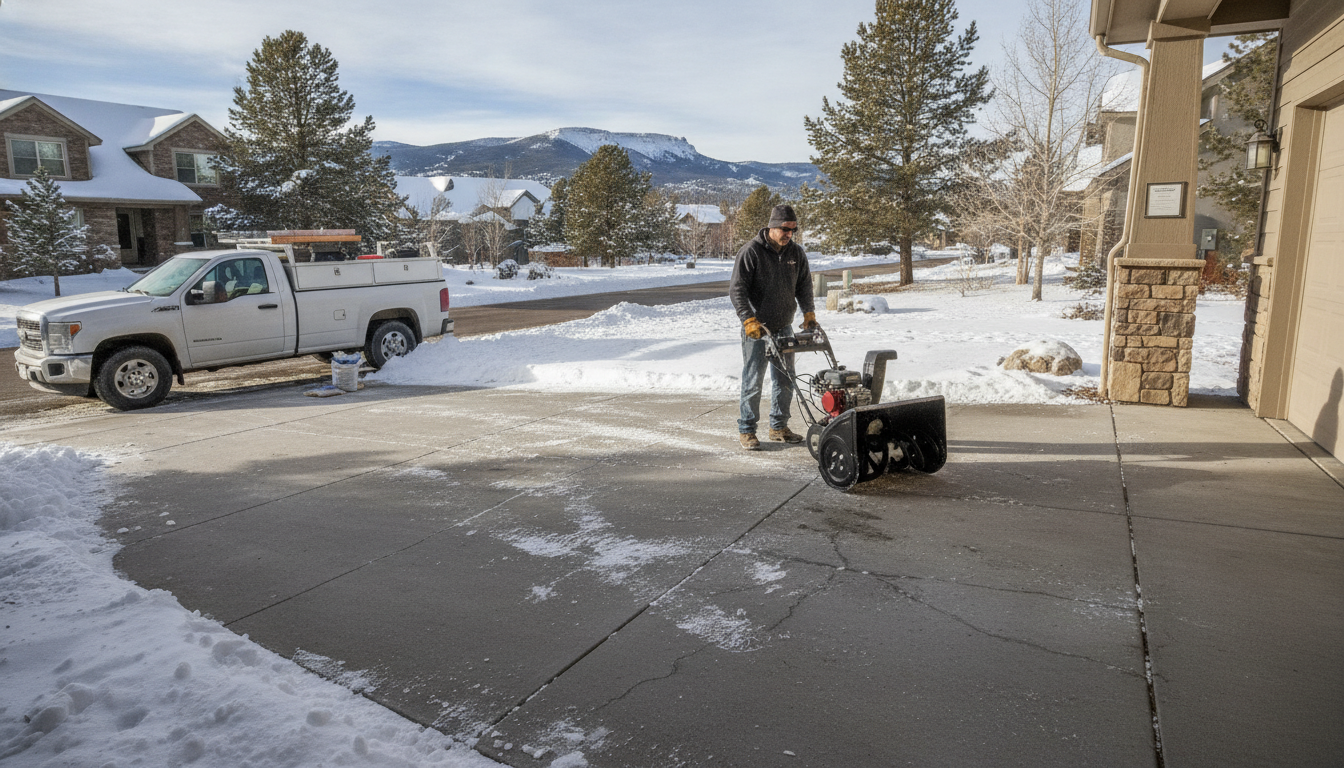
Before you buy ice melt this winter, learn how rock salt permanently damages concrete driveways in Palmer Divide towns like Monument and Woodmoor.
Every fall, as the first cold snap hits the Palmer Divide, hardware store shelves fill up with bags of rock salt and ice melt. It feels like the responsible thing to do — clear the ice, keep everyone safe. But before you buy a bag this year, it's worth understanding exactly what that salt does to your concrete driveway, because the damage it causes cannot be undone.
How Salt Actually Damages Concrete
Concrete isn't solid all the way through — it's porous, full of microscopic pockets that absorb moisture. When you spread rock salt or chloride-based ice melt on a driveway, it lowers the freezing point of the snow and ice sitting on top, turning it into meltwater. That meltwater doesn't just sit there; it soaks down into those pores.
Here's where the real problem starts. Once the sun goes down and temperatures drop again, that absorbed water refreezes — but now it's trapped inside the concrete instead of sitting on the surface. Water expands by about 9% when it turns to ice. Multiply that expansion across thousands of tiny pores, night after night, storm after storm, and you get a slow, relentless pressure building from the inside of the slab outward.
Scaling and Spalling: What It Looks Like
This freeze-thaw cycle is what causes the pitted, flaking, crumbly surface you've probably seen on older driveways and sidewalks around Colorado Springs and the Tri-Lakes area. In the trade, we call this scaling and spalling — the top layer of concrete literally breaks away in chips and flakes, exposing rougher, weaker concrete underneath. Once scaling starts, it doesn't heal or reverse. It only spreads.
Rebar Corrosion: The Damage You Can't See
It gets worse below the surface. Many driveways, walkways, and patios have steel reinforcement — rebar or wire mesh — embedded inside the concrete for structural strength. Chloride ions from rock salt migrate down through those same pores and reach the steel, accelerating corrosion. As steel rusts, it expands, putting outward pressure on the concrete surrounding it from the inside. This is how you end up with cracking and structural failure that has nothing to do with the surface wear you can see — the damage started underneath, invisible, until a section of the slab finally gives way.
New Concrete Is the Most Vulnerable
If you've recently poured a new driveway or patio anywhere from Monument to Black Forest to Palmer Lake, be especially cautious. Concrete continues curing and hardening for up to a year after it's poured, and it's far more porous and vulnerable during that window. Salt applied to new concrete causes dramatically faster and more severe scaling than the same salt on an older, fully cured driveway.
Why S&C Never Salts — Ever
This is exactly why S&C Landscaping never applies rock salt or chloride-based ice melt to any driveway, walkway, path, or step we clear — on any surface, for any customer, ever. We clear snow mechanically instead, which protects your concrete's surface and structure for the long run. It also means no salt tracked indoors on boots and paws, and no chloride runoff killing the plants and lawn along your walkway edges.
If you've noticed one particular spot on your driveway that ices over every single storm no matter what you do, that's usually not a salt problem — it's a drainage or grading issue sending water to the wrong place. That's something we can actually fix, rather than masking it with more ice melt each winter.
Serving the Palmer Divide Snow Removal Towns
S&C Landscaping provides driveway and walkway snow removal to Woodmoor, Monument, Black Forest, Palmer Lake, and Gleneagle — the Palmer Divide towns that sit around 7,000 feet and reliably see heavier, wetter snow earlier and later in the season than Colorado Springs a few miles south. If you're outside those five towns, reach out anyway — we can have the team confirm whether we're able to reach you. And year-round, we handle full landscape design, installation, xeriscaping, and seasonal yard cleanups across our broader 35-mile service area around Monument, including Falcon, Peyton, Fountain, Manitou Springs, Woodland Park, and Castle Rock.
Frequently Asked Questions
Does salt really damage a concrete driveway, or is that overstated?
It's not overstated — the freeze-thaw cycle salt creates is a well-documented cause of concrete scaling, spalling, and rebar corrosion. The damage is cumulative and permanent; once scaling starts, it doesn't reverse, and it tends to get worse with each additional salt application.
What can I use instead of salt on my driveway this winter?
The safest long-term approach is prompt mechanical removal — clearing snow before it compacts into ice — rather than relying on any chloride-based product. S&C clears driveways, walkways, paths, and steps mechanically and never applies salt or ice melt, which protects your concrete, your pets' paws, and the plant beds along your walkway.
My driveway ices over in the same spot every storm — is that a salt problem?
Usually not. Recurring ice in one specific spot is typically a sign of drainage or grading sending water where it shouldn't go. S&C addresses drainage and grading issues directly rather than recommending more ice melt as a workaround.