Ice Melt Alternatives for Concrete Driveways in Colorado
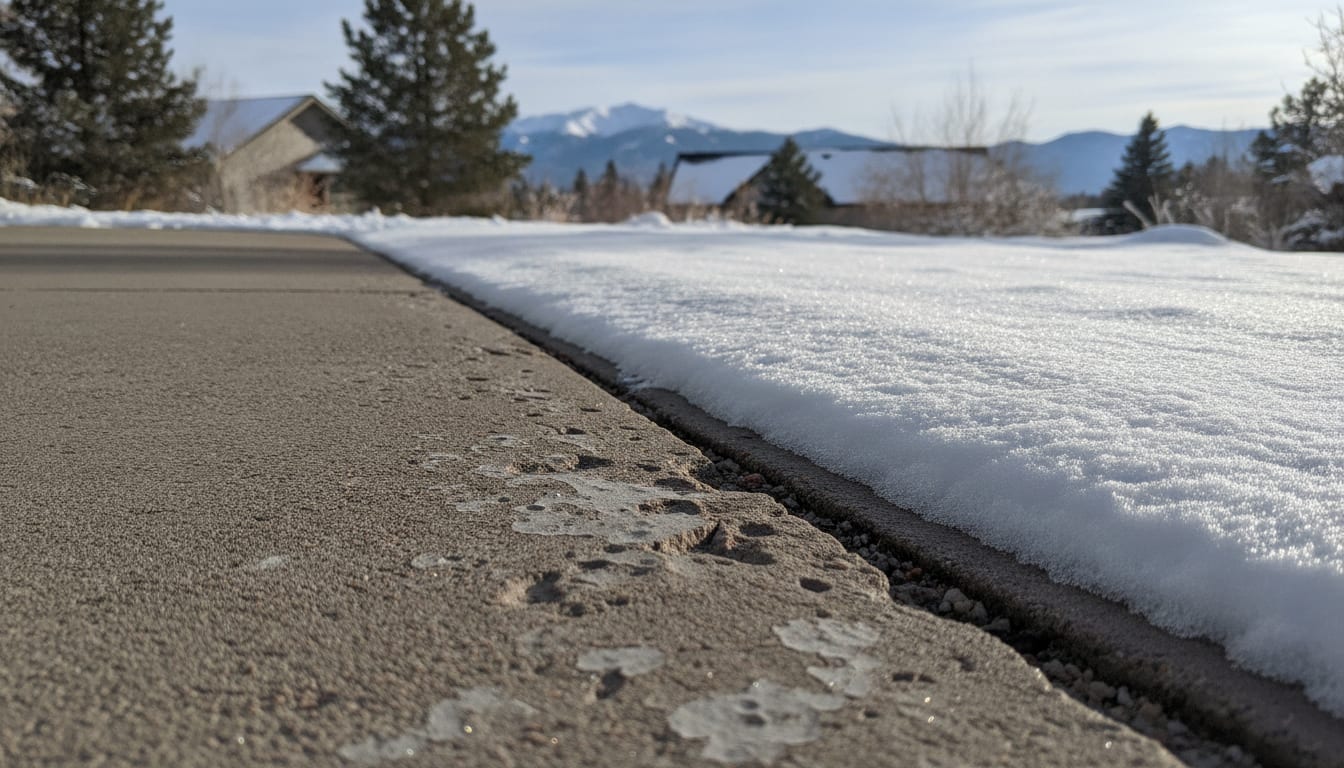
Stocking up on ice melt this year? Learn safer alternatives for concrete driveways and why S&C clears Palmer Divide snow mechanically, never with salt.
As the first cold snaps roll across the Palmer Divide, it's that time of year when homeowners head to the hardware store and stock up on bags of ice melt. Before you load up the cart, it's worth understanding what those products actually do to a concrete driveway over time — and what to use instead if you want your concrete to last.
Why Ice Melt Isn't the Free Pass It Seems
Rock salt and chloride-based ice melts work by lowering the freezing point of water, which melts surface ice quickly. The problem is what happens next. That meltwater doesn't just disappear — it soaks into the tiny pores of the concrete, then refreezes overnight when temperatures drop again. Ice takes up more space than water, so this freeze-thaw cycle slowly pushes the surface apart from the inside. Over a season or two, you end up with pitting, flaking, and scaling that no amount of sealant can fully reverse. Concrete that's less than a year old is especially vulnerable, since it hasn't fully cured and hardened yet.
Beyond the concrete itself, chloride products corrode the steel reinforcement inside the slab, get tracked indoors on boots and paws, and wash into the garden beds along the driveway edge — where they can kill grass, shrubs, and perennials. If you've invested in native plants or drought-tolerant landscaping around your entryway, salt runoff can undo that work fast.
What to Use Instead
If you still want a product on hand for walkways, look for calcium magnesium acetate (CMA) or sand and traction grit as lower-impact options. CMA is gentler on concrete and vegetation than rock salt, though it's still a chemical product and shouldn't be relied on as a primary strategy. Sand won't melt ice, but it adds traction on steps and paths without any chemical exposure to your slab or soil.
The better long-term approach, though, is mechanical removal — physically clearing snow before it has a chance to compact into ice. This is exactly how S&C Landscaping handles driveway and walkway snow removal for homeowners in Woodmoor, Monument, Black Forest, Palmer Lake, and Gleneagle. We never apply salt, rock salt, or any chloride-based ice melt to a driveway or walkway, on any surface, ever. Snow is cleared with equipment, not chemicals.
Why We Clear Mechanically Instead
We're proud of this approach because it protects the things that matter: your concrete, your soil, your pets, and your flooring. Up on the Palmer Divide, towns like Woodmoor, Monument, Black Forest, Palmer Lake, and Gleneagle sit around 7,000 feet and reliably catch heavier, wetter snow earlier and later in the season than Colorado Springs does just a few miles south. That makes timely mechanical clearing even more important — getting snow off before it packs down reduces the temptation to reach for the ice melt bag in the first place.
If you notice one spot on your driveway or walkway that ices over after every single storm, that's often not a snow problem at all — it's a drainage or grading issue sending water to the wrong place. That's something S&C can evaluate and correct as part of our broader landscape installation work, alongside patios, walkways, and hardscaping designed for Colorado's climate and terrain.
Serving the Palmer Divide and Beyond
Snow removal is available to homeowners and HOAs in Woodmoor, Monument, Black Forest, Palmer Lake, and Gleneagle. If you're outside those five towns, let us know your city or ZIP and we'll have the team confirm whether we can reach you. And while winter keeps our crews busy clearing driveways and steps, we're also planning ahead for spring and fall yard cleanups, xeriscaping, and landscape design across the wider service area — from Monument and Castle Rock to Falcon, Peyton, Fountain, Manitou Springs, and Woodland Park.
Every snow removal job is priced after a free on-site visit, since driveway length, layout, and conditions all factor in. If you're ready to get on the schedule, share your name, phone, email, and city, and our family-owned team — Simeon and Chris, with 15 years of combined experience — will follow up to set things up.
Frequently Asked Questions
Is any ice melt product actually safe for my driveway?
No ice melt product is completely risk-free for concrete, though calcium magnesium acetate is generally gentler than rock salt. Sand or grit for traction, combined with prompt mechanical snow removal, is the safest overall approach for your slab and your yard.
Why doesn't S&C use salt or ice melt at all?
Salt and chloride ice melt force a freeze-thaw cycle that permanently scales and pits concrete, corrode the reinforcement inside the slab, track indoors on boots and paws, and wash into nearby garden beds where they harm plants. We clear snow mechanically instead, which avoids all of that damage.
What if the same spot on my driveway keeps icing over?
A spot that ices over after every storm is usually a sign of a drainage or grading problem directing water to that area, not something an ice melt product can fix long-term. Our team can assess the grading and recommend a lasting correction.